

Burrowing Owl Surveys, Monitoring, and Compliance: A State-by-State Planning Guide (CA, NV, AZ)
What project teams and biologists need to know before ground disturbance in California, Nevada, and Arizona.
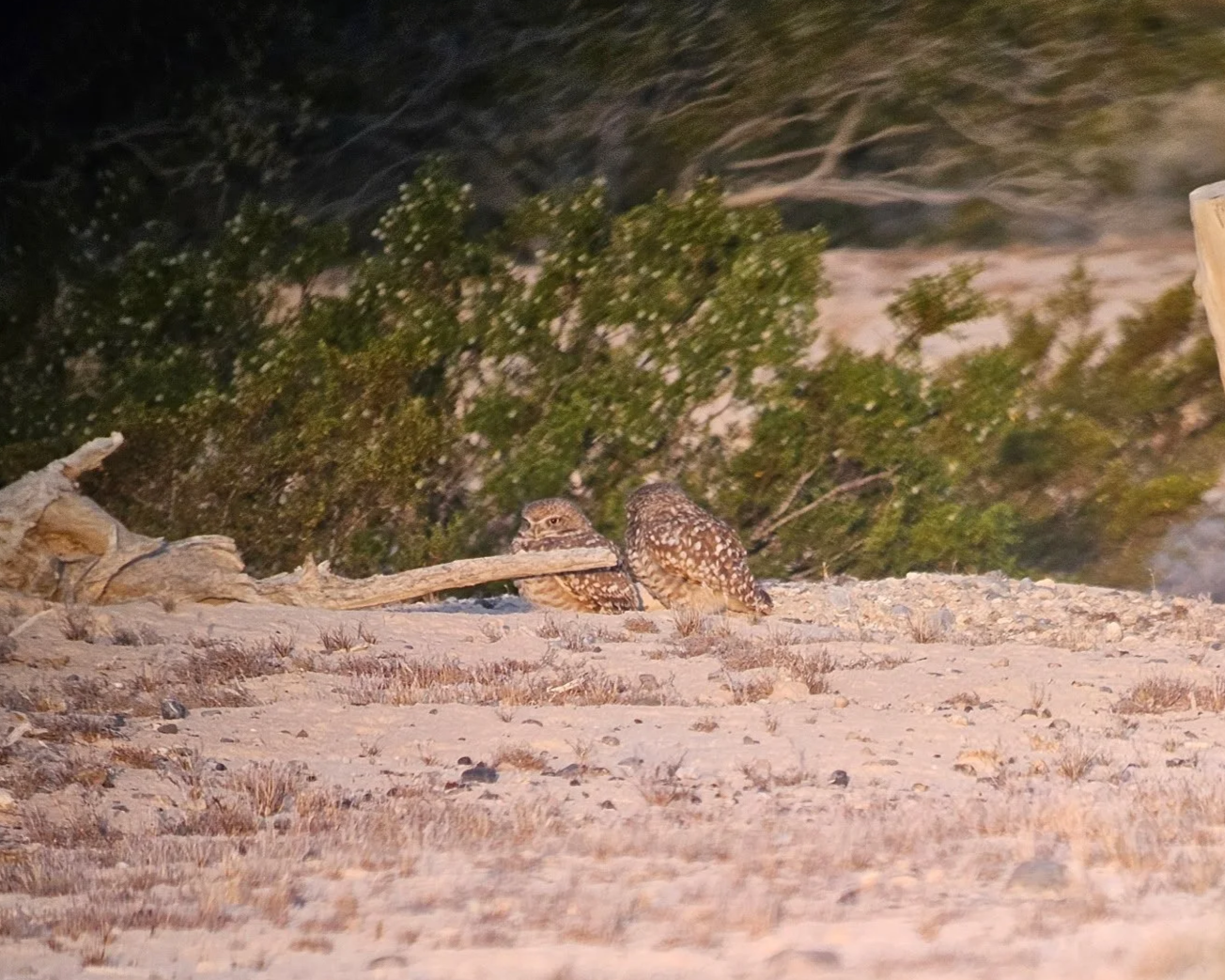
Western burrowing owl (Athene cunicularia hypugaea) turns up on project after project across the Desert Southwest, and on many federal projects it is also a Bureau of Land Management (BLM) sensitive species. If your footprint sits in California, Nevada, or Arizona, plan to answer three questions early: is there suitable habitat, are owls present, and what has to happen before the ground is disturbed?
Field work looks about the same in all three states. The compliance path does not. California is far more involved than Nevada or Arizona, and that gap can reshape a schedule and a biological budget. This guide walks through the shared field work first, then breaks down requirements state by state so you can plan and budget with confidence.
Where Burrowing Owls Live
Burrowing owls favor open, dry ground: grasslands, desert scrub, agricultural edges, vacant lots, roadsides, airports, golf courses, and utility corridors. Unlike most owls, they nest underground and rarely dig their own homes. They move into holes made by ground squirrels, prairie dogs, badgers, foxes, and tortoises, and they readily use culverts, pipes, storm drains, and debris piles.
Agency habitat descriptions line up closely. CDFW ties high-quality habitat to ground squirrel colonies and short vegetation. NDOW reports owls throughout Nevada wherever burrowing mammals and open ground occur, including lots near people, with year-round residents in the south. AZGFD lists treeless short-grassland, desert scrub, agricultural fields, and even parking lots and storm drains.
Quick life history: burrowing owls are small, long-legged owls that live and nest underground and hunt day and night, feeding mostly on insects and small rodents. Pairs are generally monogamous, nest in loose colonies, and lay large clutches of roughly six to nine eggs. Northern populations migrate, while owls across the Desert Southwest are largely year-round residents. Numbers are falling: California colonies declined about 60 percent from the 1980s to the early 1990s, and the owl is now absent from roughly a third of its former statewide range, driven mainly by habitat loss and urban development.
What a Burrowing Owl Survey Looks For
A survey answers one question: are owls, or signs of owls, using the site, and where? Because these birds spend so much time underground, sign often reveals their presence before a bird is seen. On foot, surveyors record:
Burrows and burrow-like openings, including culverts, pipes, and storm drains
Owls standing at or near burrow entrances
Whitewash, regurgitated pellets, feathers, and prey remains
Mammal dung or small debris arranged near the entrance
Alarm calls, defensive behavior, or adults returning to the same burrow
Juveniles or recently fledged young
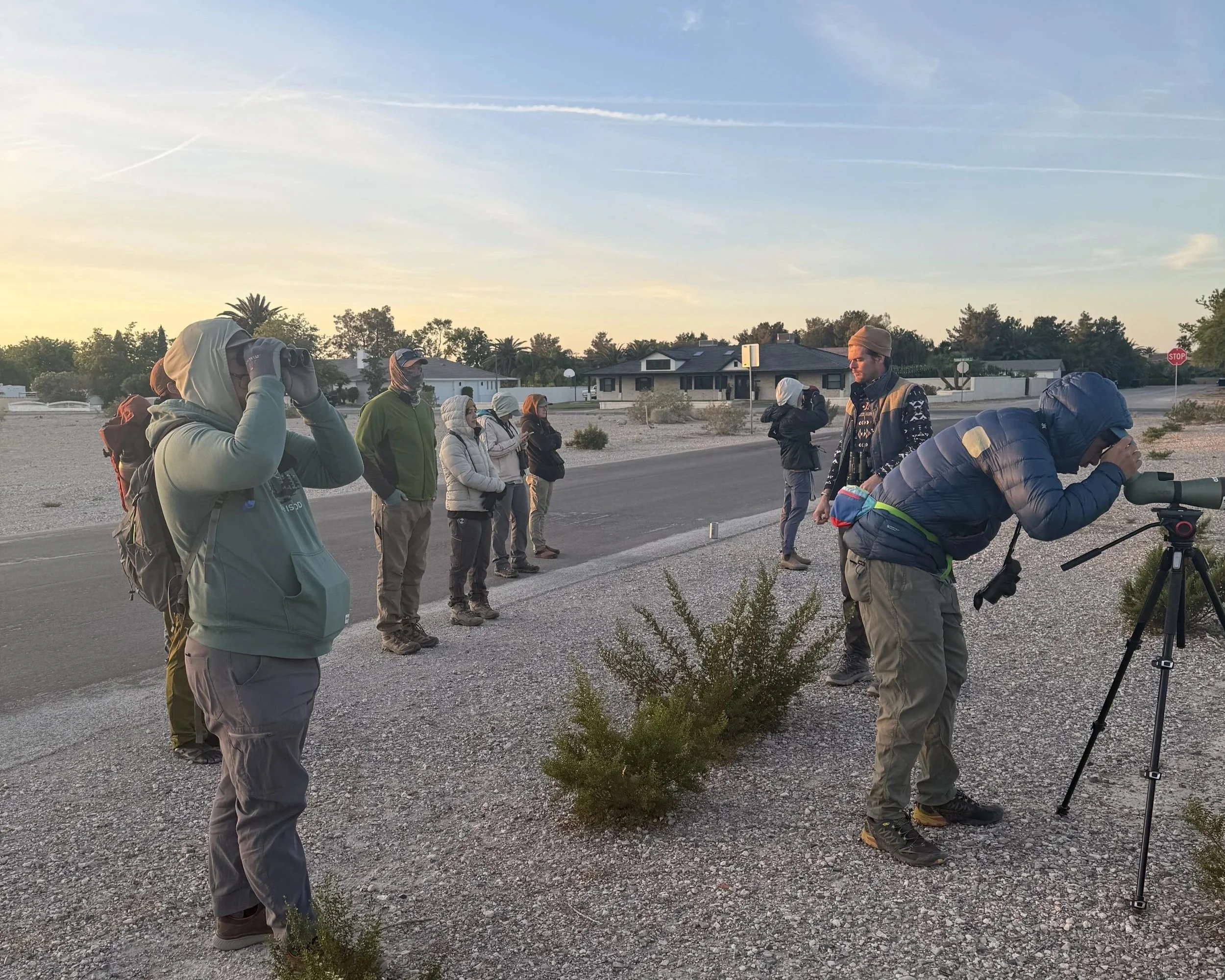
Detection depends on timing and coverage. Owls are most visible near sunrise and sunset, so surveyors should aim to survey during those windows (when possible) and favorable weather.
Survey Methods: The Standard and the Alternatives
Most protocols use pedestrian belt transects spaced so the observer sees all of the ground, commonly about 10 meters apart and tighter in dense vegetation.
Linear projects such as pipelines, transmission lines, and roads often call for a different approach. Surveyors run point counts at set intervals along the corridor, scan each point with binoculars, and, where the agency allows it, broadcast a burrowing owl call to prompt a response. This method follows the project shape, the lead agency’s direction, and the permit conditions.
The Regulatory Picture: Federal Floor, State Ceiling
Federally, burrowing owls are protected under the Migratory Bird Treaty Act (MBTA), which covers migratory birds, their active nests, and their eggs. The species is not listed under the federal Endangered Species Act, but it is routinely treated as a sensitive or special-status species. On BLM land, requirements can also appear in National Environmental Policy Act (NEPA) documents, right-of-way conditions, biological opinions, and project-specific mitigation.
Think of the MBTA as the federal floor that applies everywhere. State agencies, local plans, and permit conditions set the ceiling, and that ceiling is what separates a California project from a Nevada or Arizona one.
Translocation and Passive Relocation: What to Expect
When owls occupy burrows inside a footprint that will be cleared, a project must either avoid the burrows or move the birds off the site. Two approaches are common. Passive relocation, or eviction, installs one-way doors on burrow entrances so owls can leave but cannot return, paired with nearby alternative or artificial burrows. Active translocation captures owls and moves them to a prepared receptor site, often with artificial burrows installed.
Both carry real biological risk. A bird pushed off chosen habitat onto unfamiliar ground does not always survive and breed. Habitat loss is the single biggest driver of the species' decline, which is a major reason California now treats relocation so cautiously. For planning, expect a project manager to account for the following once relocation is on the table:
Timing work outside the breeding season. In California the breeding season runs February 1 through August 31, and passive relocation is limited to September 1 through January 31, only after a biologist confirms juveniles are foraging on their own.
Non-disturbance buffers around occupied burrows during construction, sized by disturbance level and time of year.
One-way doors on occupied burrows, plus alternative or artificial burrows nearby, often more burrows than were removed.
Qualified / Approved biologists to install exclusion devices, monitor, and document the process.
Agency coordination, and in California an Incidental Take Permit (ITP) before any occupied burrow is disturbed.
Post-relocation monitoring and reporting over a defined period.
Quick Blueprint: California vs. Nevada vs. Arizona
Use this as a fast planning reference. It shows what is broadly shared and where the three states diverge.
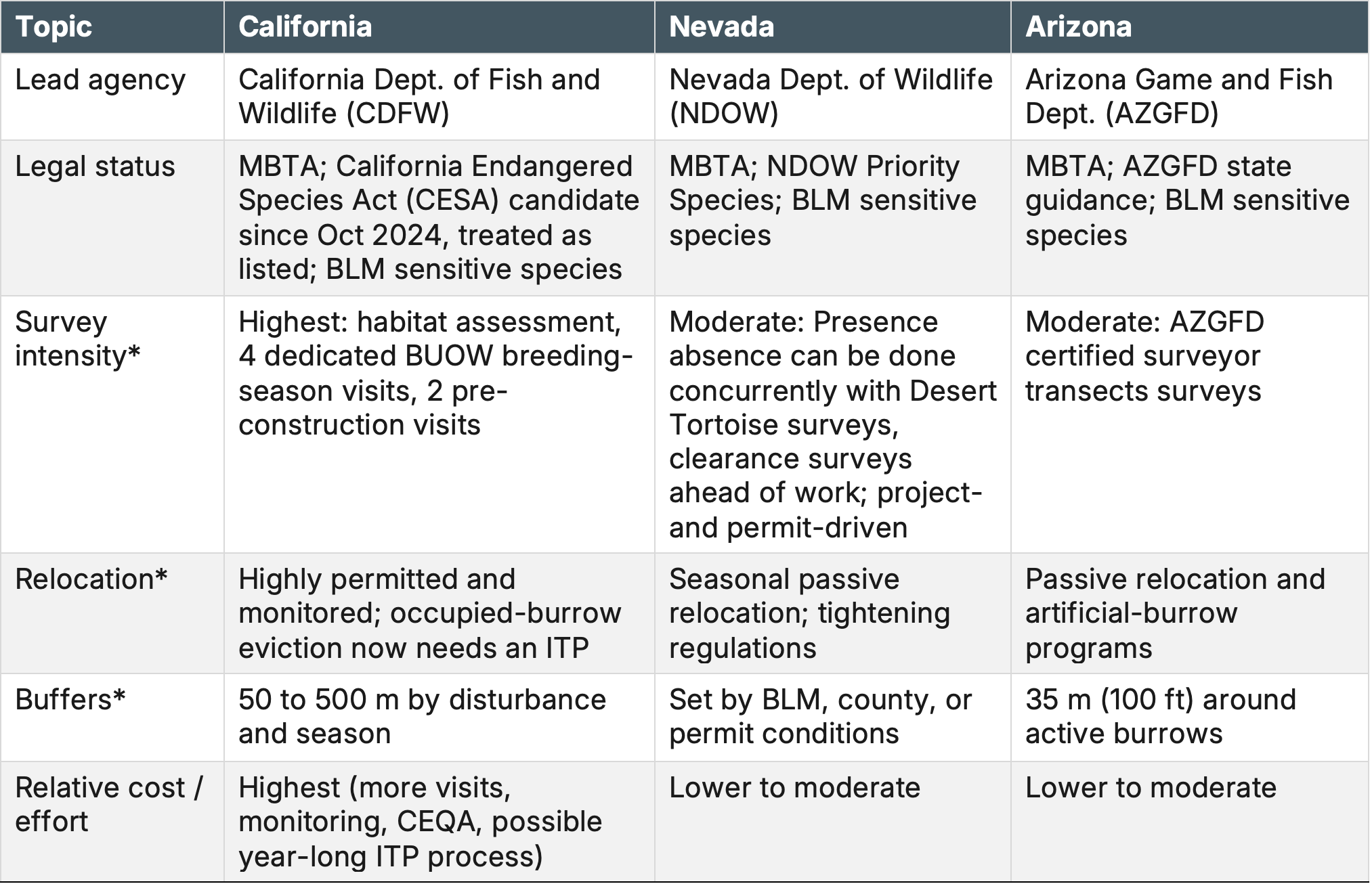
*Can vary project to project. Always confirm with the lead agencies and/or project permits before surveying, relocating, or buffering.
If a project crosses from Nevada into California, the same owl can drive far more survey visits, more monitoring, and formal agency coordination on the California side. Budget the California portion on its own rather than assuming one number covers the whole corridor.
California: The Most Demanding of the Three
Status and lead agency
CDFW is the lead state agency. The western burrowing owl became a candidate under the California Endangered Species Act (CESA) in October 2024, which means it now receives the same protection as a listed species while the review runs. The California Fish and Game Commission granted CDFW a six-month extension in October 2025, opened public comment through April 25, 2026, and set the earliest possible listing decision for its August 2026 meeting. Until then, take is prohibited without authorization.
Surveys
CDFW's 2012 Staff Report on Burrowing Owl Mitigation remains the guiding document. A California program typically starts with a habitat assessment, then moves to focused breeding-season surveys built on four site visits: the first between February 15 and April 15 to map burrows, and three more between April 15 and July 15, spaced at least three weeks apart, with at least one after June 15. Surveyors walk transects about 20 meters apart for full visual coverage and work near sunrise and sunset. Before ground disturbance, a pre-construction take-avoidance survey adds two more visits, one about 14 days before work and one within 24 hours of it.
Buffers and translocation
Avoidance buffers generally range from 50 to 500 meters, depending on the disturbance level and season, with the largest buffers during nesting. The bigger shift is on relocation: because passive relocation of occupied burrows can constitute take, it should no longer be done in California without an ITP, and an ITP can take more than a year to secure after application. Teams that expect owls should confirm the need for take coverage as early as possible.
CEQA overlay
Most California development also triggers the California Environmental Quality Act (CEQA), which can require impact analysis, mitigation, documentation, and agency coordination for biological resources.
CEQA review, additional survey passes, and stricter monitoring together push California timelines and biological compliance costs above comparable work next door.
Recent example: the Town of Apple Valley Burrowing Owl Relocation Plan (2025) shows how a current, post-candidacy California project structures avoidance, buffers, and relocation under the 2012 Staff Report framework.
Nevada: Project-Specific and Often Tied to BLM or Local Plans
Status and lead agency
NDOW is the lead state wildlife agency and lists the western burrowing owl as a Priority Species, present throughout Nevada in habitat that supports burrowing mammals. There is no single statewide burrowing owl clearance protocol. Requirements instead come from a mix of sources: MBTA protection, NDOW coordination, BLM sensitive-species direction, NEPA documents, local conservation plans, and project-specific permit conditions.
Clark County clearance protocol
In southern Nevada, the Clark County Desert Conservation Program's Multiple Species Habitat Conservation Plan (MSHCP) sets the clearest local standard. Its clearance protocol calls for a single pass with 100 percent coverage of the project area. Any burrow showing sign such as feathers, whitewash, eggshells, or litter is inspected with a bright light and mirror or scoped. Occupied burrows are left intact and marked for passive relocation, while confirmed vacant burrows are closed to block reentry. Biologists must meet the current USFWS desert tortoise Authorized Biologist standards and complete the program's species clearance class. In Nevada, desert tortoise (DETO) and burrowing owl (BUOW) clearances are often conducted concurrently, which is why this program applies the same tortoise-authorized biologist standard.
Relocation and monitoring
Passive relocation is used on many Nevada projects, generally outside the breeding season, but the exact process should be confirmed against the project's permits, agency direction, and any BLM or county requirements. Nevada is gradually tightening its approach, so early confirmation matters, especially on BLM land and on large renewable energy, transmission, utility, and road projects.
Recent example: a BLM Burrowing Owl Management and Passive Relocation Plan prepared for a southern Nevada project (BLM ePlanning, 2022). Plans like it typically require pre-construction clearance surveys, one-way-door eviction outside the breeding season, installation of replacement artificial burrows, buffers around occupied burrows, and post-eviction monitoring.
Arizona: Published Clearance Guidance and Certification
Status and lead agency
AZGFD is the lead state wildlife agency and publishes a Burrowing Owl Project Clearance Guidance developed with state, federal, and other experts. The guidance standardizes survey work where burrows may be disturbed and helps landowners avoid violating the laws that protect the species. It recommends visual transect surveys for owls and burrows, and it directs that only trained, certified individuals conduct the survey.
What Arizona planning includes
Early preliminary surveys and surveyor certification
10-meter transects, or spacing that gives full visual coverage
Reporting survey areas, tracks, times, and detections to AZGFD within 30 days
Coordination with the agency if owls or active burrows are found
A 35-meter (100-foot) buffer around active burrows that excludes heavy machinery and foot traffic until a conservation action is set
Passive relocation and artificial-burrow programs when appropriate
Recent example: at an Arizona solar farm, developer Longroad Energy and the rehabilitation center Wild at Heart installed about 40 artificial burrows and relocated owls onto the site, a working model of active translocation paired with constructed habitat (reported by Audubon).
Monitoring: What Each State Expects
California asks the most: biological monitors during ground disturbance near buffers, compliance monitoring under any ITP, and reporting to CDFW.
Nevada monitoring is project-specific, set by BLM decision records, Clark County clearance, or permit conditions, with relocation monitored seasonally.
Arizona relies on certified-surveyor monitoring, enforcement of the active-burrow buffer, and detection reporting to AZGFD within 30 days.
The Bottom Line for Planning
Habitat and field signs look alike across California, Nevada, and Arizona while the compliance path is wildly different. The MBTA sets the federal floor. CDFW guidance, CEQA, and CESA candidate protections make California the most demanding. Nevada is project-specific and often tied to BLM, NDOW, or Clark County requirements. Arizona runs on published clearance guidance and surveyor certification, which arguably makes it the easiest for planning and budgeting.
If owls could be present, start early. Check the habitat, schedule surveys in the right window, confirm state requirements, budget for biological support, and brief the construction crew on what to do if owls or active burrows appear.
How Desert Shield Can Help
Desert Shield Environmental Professionals supports project teams with burrowing owl surveys, avian and biological monitoring, construction monitoring, compliance planning, and agency-ready documentation across the Desert Southwest. Our team handles habitat assessments, focused and pre-construction surveys, burrow and sign documentation, GPS mapping, buffer and avoidance planning, and coordination that keeps a project moving.
If your project is in California, Nevada, Arizona, or another region where burrowing owls may be present, reach out early. The best time to plan for burrowing owl surveys and monitoring is before the schedule is already at risk. Contact Desert Shield to discuss your project location, timeline, and survey needs.
Authorities and Source Links
USFWS Burrowing Owl Species Profile:https://ecos.fws.gov/ecp/species/9737
USGS Burrowing Owl Range Map Data:https://www.usgs.gov/data/burrowing-owl-athene-cunicularia-bbuowxconus2001v1-range-map
CDFW Western Burrowing Owl CESA Candidate News:https://wildlife.ca.gov/News/Archive/fish-and-game-commission-western-burrowing-owl-becomes-cesa-candidate-wildlife-prosecutor-of-the-year-named-waterfowlers-hall-of-fame-inductees-recognized
CDFW 2012 Staff Report on Burrowing Owl Mitigation:https://nrm.dfg.ca.gov/FileHandler.ashx?DocumentID=83843
NDOW Western Burrowing Owl Species Page:https://www.ndow.org/species/western-burrowing-owl/
Clark County Desert Conservation Program Burrowing Owl Clearance Protocol:https://www.clarkcountynv.gov/assets/documents/government/departments/environment_and_sustainability/desert_conservation_program/clearance-protocols-draft-appendix-x-burrowing-owls.pdf
AZGFD Burrowing Owl Project Clearance Guidance:https://azgfd-wdw.s3.amazonaws.com/awcs-2022/documents/BurrowingOwlClearanceProtocol_2009.pdf
Audubon: How Burrowing Owls Found a Home on an Arizona Solar Farm:https://www.audubon.org/magazine/how-burrowing-owls-found-home-arizona-solar-farm
BLM ePlanning (project-specific NEPA records):https://eplanning.blm.gov/
CEQAnet (California CEQA documents):https://ceqanet.opr.ca.gov/
