

Desert Tortoise Clearance Surveys: Clearing the Site Before Ground Disturbance
How desert tortoise clearances work, when they are required, and what it takes to move tortoises safely, legally, and within protocol so you can properly plan your schedule and budget.
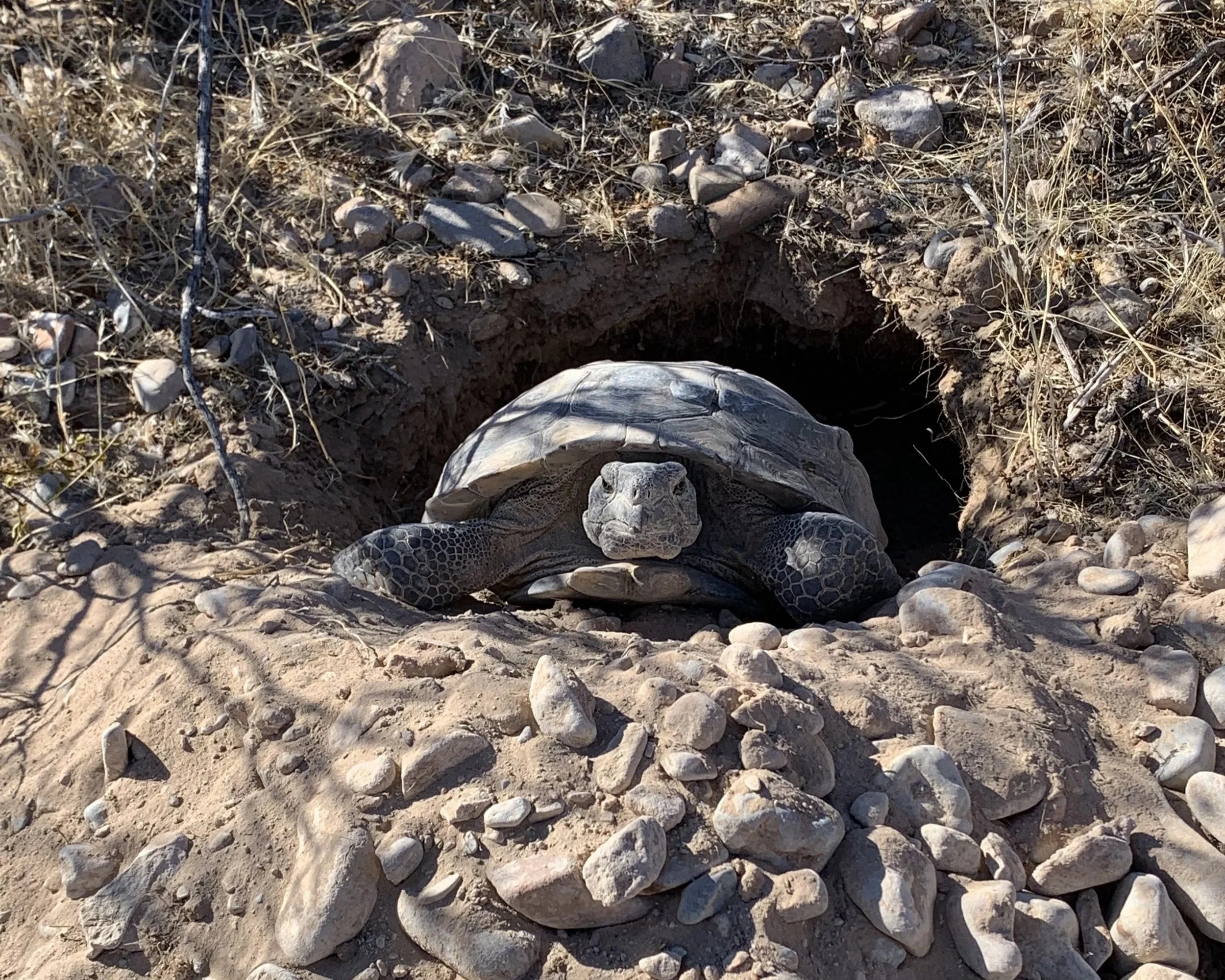
About this series
This three-part series follows a project from first look to final grading. Part 1 covers presence/absence surveys, the pre-project step that shows whether tortoises use your site. Part 2 (this article) covers clearance surveys, the full-coverage sweep that removes tortoises after fencing and before ground disturbance. Part 3 covers construction monitoring, the daily compliance work that keeps a project inside its permit.
Clearance survey vs. presence/absence survey
A clearance survey is the step before ground disturbance (grading and the like) to remove the federally protected, threatened desert tortoise. Trained biologists comb through 100 percent of the project footprint multiple times and transmitter or translocate every animal they find out of the project footprint. The goal of a clearance survey is to remove every tortoise possible ahead of groundbreaking. (USFWS 2009, Desert Tortoise Field Manual)
This is a different job from the presence/absence survey in Part 1. A presence/absence survey answers whether tortoises use the site and, on larger projects, how many. It is used for project planning and NEPA compliance. A clearance survey acts on that information by physically clearing the footprint immediately ahead of construction. One does not replace the other. You still need the presence/absence data that agencies use for consultation and permitting, and you still need clearance before dirt work starts. The two are often done a couple of years apart, depending on how fast your project moves through the permitting pipeline.
When a clearance survey is required
Clearance surveys apply to projects in the range of the desert tortoise, and they are usually written into the biological opinion or incidental take permit as a Term and Condition. Linear and permanently disturbed sites such as pipelines, roads, and transmission lines almost always require one. Anytime there is overland travel or ground disturbance, a clearance survey will generally be required. (USFWS 2009)
Reach out when you are not sure whether your project triggers a clearance survey, or how it fits into your permit timeline. Desert Shield has cleared linear corridors, solar fields, and substations across the Las Vegas and California Mojave, and we can tell you early what your permit will require.
Timing, and the role of the fence
Clearance surveys can happen in two ways, depending on the type of disturbance. For linear work, small projects, overland travel, or unfenced work areas, clearance happens immediately ahead of the disturbance, with the biologist clearing ahead of the work. For larger work areas that will require long-term work, such as solar fields or substations, the work areas are first fenced with tortoise-proof fencing, and then the enclosed area is immediately surveyed to clear it of tortoises. Once cleared, the monitoring requirements are reduced because the area is considered “cleared.”
Clearance must occur during the active season, generally April and May or September and October, when tortoises are moving and easier to find. All capture, handling, and release happens between 55 F (12.8 C) and 95 F (35 C), measured in the shade about 5 cm above the ground, and animals are kept shaded until release. (USFWS 2009)
Clearance survey protocol summary
Determine the survey area. This is either the disturbance right-of-way or an enclosed, fenced project site. If it is fenced, it must use tortoise fencing per USFWS specs.
Walk transects no wider than 5 m (15 ft) apart. Surveys are usually run on a northing or an easting, but it depends on your project shapefile. Transects may need to be closer than 5 m in dense vegetation. Cover the entire area at 100 percent.
Make at least two consecutive passes across the site. Each pass should run perpendicular to the last (north-south first, then east-west). If a tortoise turns up on the second pass, USFWS and the state agency may require a third. Be prepared for three passes in good habitat.
Clear and collapse every burrow while surveying. More on this protocol below.
Translocate each tortoise off the project. A translocation can be as simple as moving a tortoise out of harm’s way or off a road less than 300 m away (short-distance translocation), or as complex as driving or even flying tortoises miles away to a new part of the desert. Sometimes agencies direct that tortoises go to a holding pen onsite. Because translocations vary so much, each project has a dedicated translocation plan spelling out exactly what is required. Tortoises given long-distance translocation are generally transmittered and tracked afterward to monitor success.
Report the area cleared and the number of tortoises found to USFWS and the state agency, in writing, within one week (or whatever your permit states). All new animal locations must be recorded.
Track the tortoises. Translocated animals often require long-term tracking and monitoring.
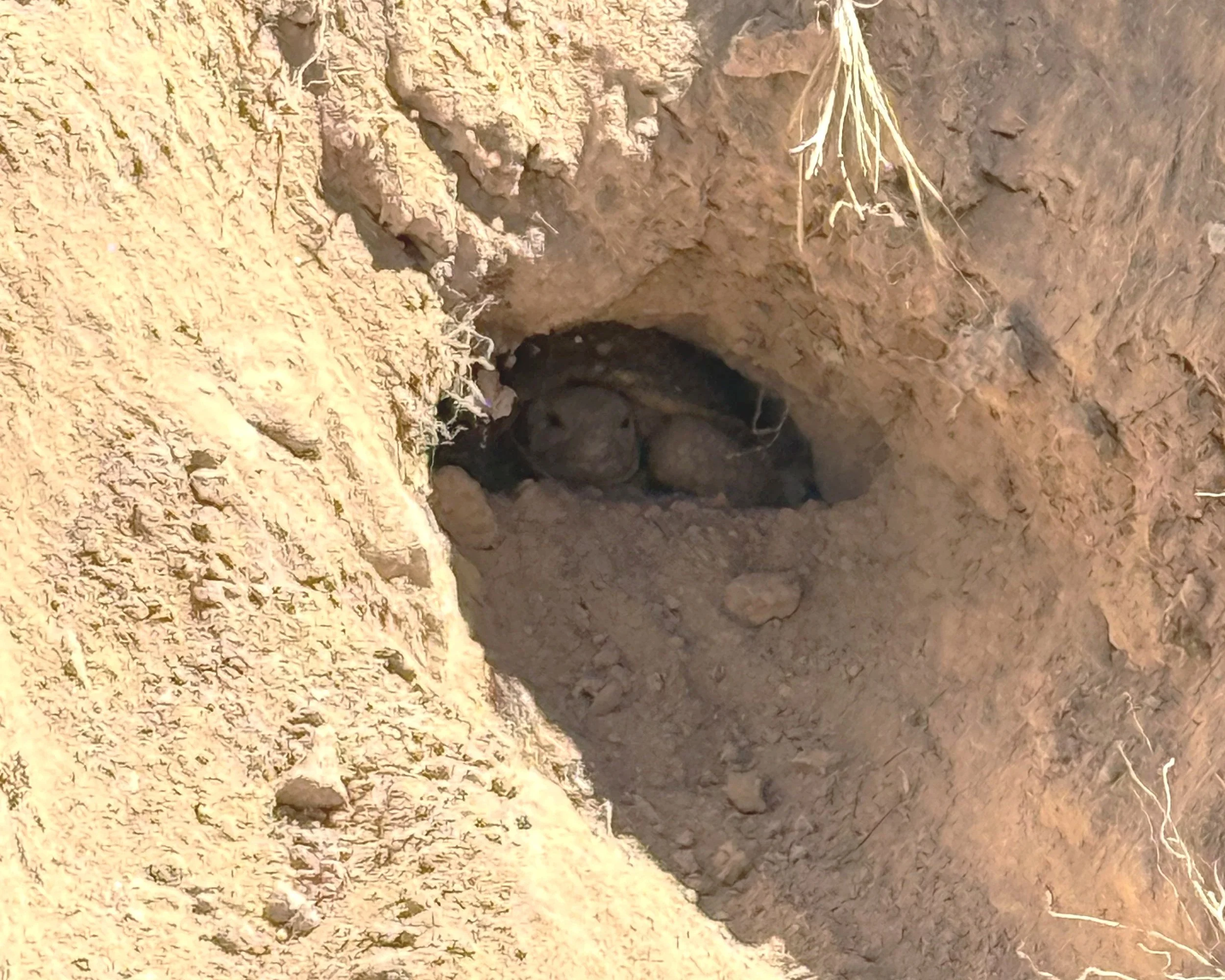
Clearing and collapsing burrows
Clearing a burrow takes the right tools and the right sequence. Before you start, have on hand a mirror, a flashlight, two shovels, a hand trowel, a probe, disinfectant spray, latex gloves, leather gloves, electrical tape, and transmitters if the tortoises will not be moved right away.
Start by checking the entrance and mouth for other occupants such as snakes, Gila monsters, scorpions, or wasps, and pull on leather or cloth gloves for this part to avoid a bite or sting. (USFWS 2009, Desert Tortoise Field Manual)
Next, feel for nests. Comb the apron with your fingers, starting at the outer edge and sweeping left to right all the way around and into the mouth of the burrow as far as you can reach. You are feeling for a hidden cavity, the spot where a finger drops into a lightly covered chamber. If you find one, feel gently inside for eggs. Eggs have been found up to 6 feet in front of an opening and 6 feet inside it, so be mindful where you step at the entrance and keep searching as you excavate. Take extra care from late April to mid-October when eggs are most likely present, especially from late April to early July. More on nest handling below. (USFWS 2009)
Once you have checked for nests, use the mirror or flashlight to look inside. If you cannot see the back, use a roughly 7-foot, quarter-inch aluminum probe, bent at the end and sanded down so it cannot injure an animal, to feel deeper. You are feeling for the tortoise and trying to coax it out on its own. You can usually tell the difference between dirt and the soft body or hard shell of a tortoise. Gently tapping or “tickling” the carapace a few times will often walk the tortoise to the front of the burrow. Nobody is quite sure why it works: some think the tortoise reacts as if an animal is on its shell, some think it senses the burrow collapsing, and some think it simply does not like the feeling. Whatever the reason, never hook or drag a tortoise with the probe, because that could injure it. (USFWS 2009)
If you cannot reach the animal, cannot get it to come out, or cannot see the back to confirm the burrow is empty, start digging. Work in small increments. The preferred method uses two people with blunt-nosed shovels: one slices the ceiling while the other clears the loosened soil so it does not backfill and bury the burrow. Feel one shovel touch the other on each stroke so you never strike a tortoise, and do not collapse the burrow ahead of your tools. Stop after every scoop to check whether a tortoise or other animal has moved toward the mouth. Check every side chamber, since small juvenile tortoises tuck into them and are easy to backfill and miss. (USFWS 2009)
When you can reach the animal, switch to clean latex gloves and grasp it firmly by the shell, holding the bridge where the carapace and plastron meet (some biologists take hold at the gular horn up front). Tortoises are strong and will push against you or brace against the burrow, so excavate close enough for a solid grip, but not so close that you risk hitting or burying it with a shovel. (USFWS 2009)
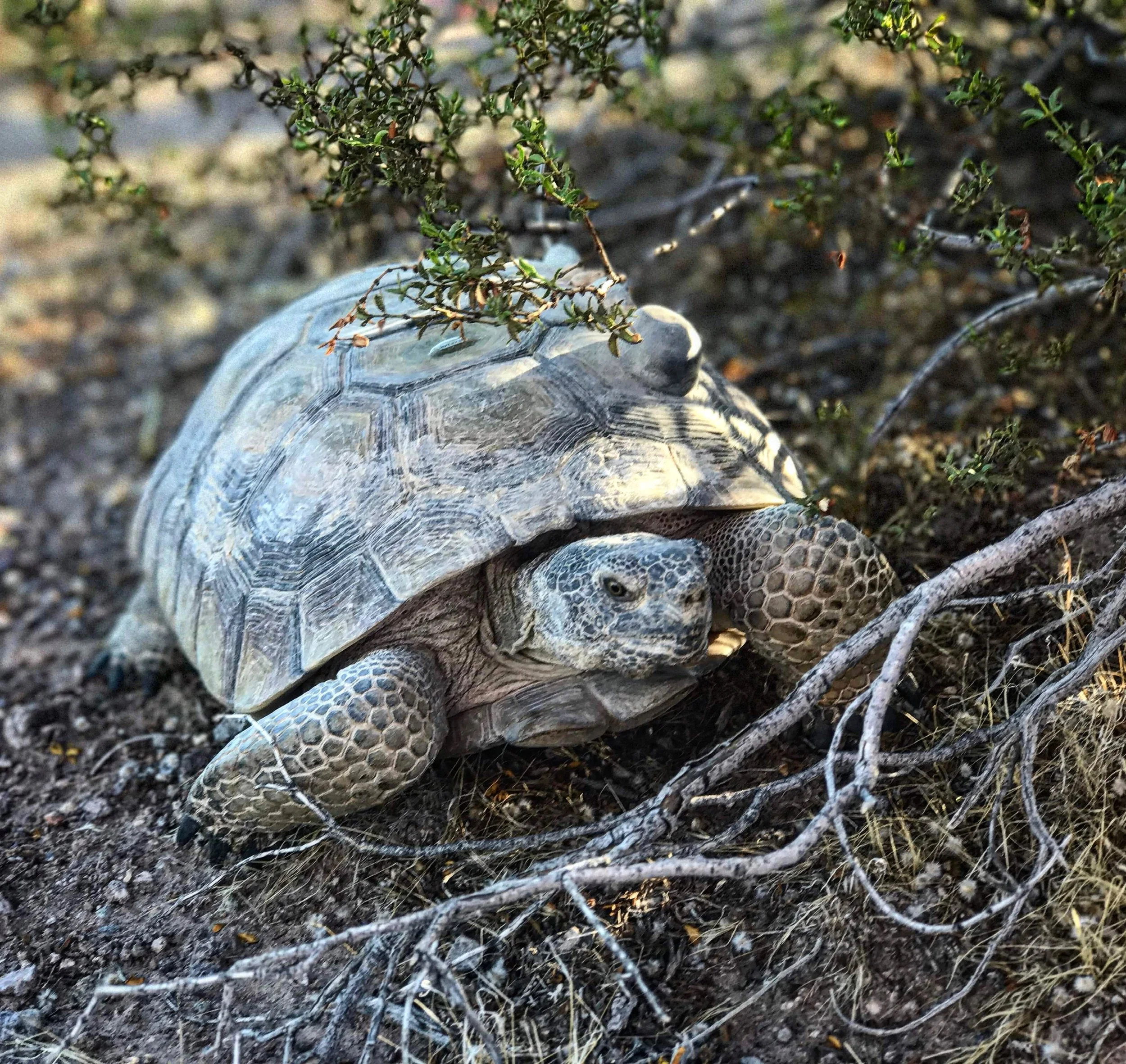
Once you have the tortoise, either hand it straight to the health assessment team or attach a temporary transmitter so it can be found later. To attach one, rinse the tortoise’s shell with water, let it dry, check that the transmitter is working once you remove the magnet, set it on the shell on the right or left forward costal scute, and wrap it in place with several turns of electrical tape around the entire shell so it will not be rubbed off by a burrow or caliche-cave roof. Pick the right size transmitter for the size and weight of the tortoise, and keep any transmitter package to no more than 10 percent of the animal’s body weight. A temporary transmitter lets the health assessment or translocation team relocate the tortoise even if they cannot get to it right away. (USFWS 2020, Translocation Guidance)
For the full protocol, see USFWS Desert Tortoise Field Manual (2009), Sections 6.4 to 6.6 and 7.7.
Clearing caliche caves
Not every shelter can be dug out. Caliche caves, the hardened calcium-carbonate dens that tortoises use in washes and cutbanks, are often deep, branching, and impenetrable. If a tortoise is (or could be) in a deep caliche cave that cannot be excavated without potentially harming it, record the location and contact USFWS for instruction rather than digging. (USFWS 2009, Desert Tortoise Field Manual)
Because you cannot clear a caliche cave by excavation, you clear it by confirming it is empty over time. Fence off the cave and immediate area with 1 inch by 2 inch welded wire mesh, and check it daily to see whether a tortoise is outside the cave. To read activity at the entrance, biologists set a “twig gate” across the opening, a few short, light twigs stuck upright in the soil that a moving tortoise will knock over. If the twigs stay undisturbed over the whole season with no tortoise sign, the cave can eventually be called vacant. Game cameras can help too. Because caliche caves are handled case by case, coordinate the method and the number of clear days with USFWS and the state agency before you rely on the result.
FROM THE FIELD, DESERT SHIELD
During one drought year, we watched a caliche cave for almost two months through the active season with no tracks and no activity, and we had assumed it was empty. Then a major storm hit at the end of May and the tortoise finally came out. It had a low body-condition score and had been staying deep and cool to conserve energy through a 100-year drought. That is why we do not call a caliche cave empty on a hunch, and why agencies may require multi-season checks.
Handling tortoises: risk of dehydration and disease
Only authorized personnel handle tortoises. If a tortoise is in immediate danger and no Authorized Biologist is present, another worker may move it to safety. Beyond that, handling should happen only under the supervision of an Authorized Biologist. (USFWS 2009)
A few main risks drive the handling rules. The first is heat: a tortoise that overheats can die, so work stops when temperatures climb toward 95 F, and animals must be shaded when handled. The second is disease. Upper respiratory tract disease, caused by Mycoplasma, helped drive the species’ decline, so biologists wear fresh gloves for each animal and disinfect any tool that touches a tortoise, using a 1 to 10 bleach solution or Nolvasan. (USFWS 2009)
Handling can also cause a tortoise to void, or release its bladder. Tortoises store water in their bladder and may empty it when startled or handled, and losing that water during drought can kill them. Biologists move animals slowly to prevent voiding, and rehydrate a tortoise that does void by soaking it or giving it an epicoelomic injection before release. See below for hydrating during drought. (USFWS 2009)
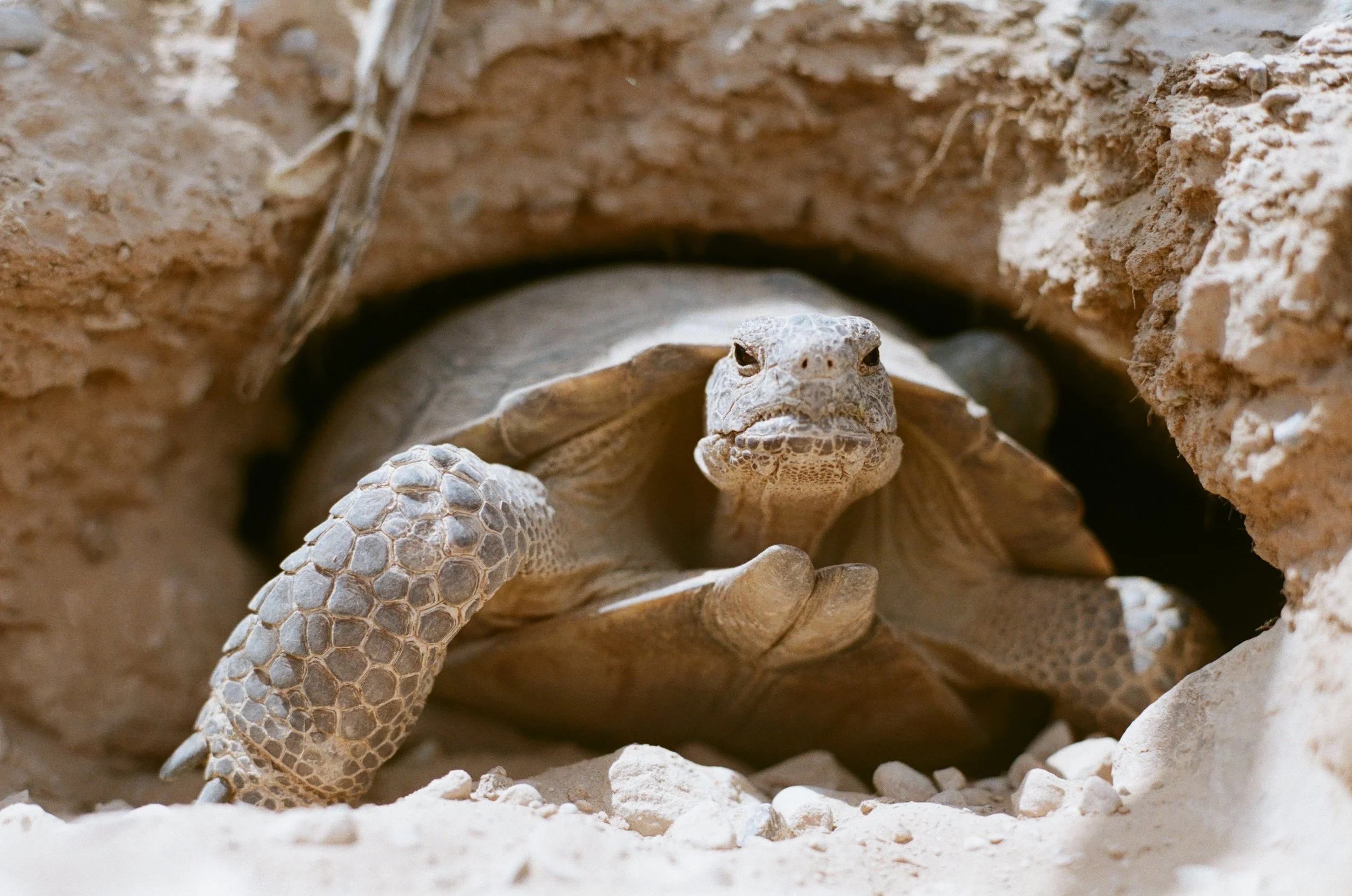
Eggs and nests are hard to find and are protected in addition to the tortoises themselves. Biologists search for nests at every burrow. If a nest is found, USFWS must be contacted immediately, because specific training is required to translocate one. Nests are excavated by hand with extreme care. The eggs are fragile and must not be turned from the orientation they developed in, because rotating them can delaminate the embryo from the inside of the shell and kill it. Eggs are kept in their original orientation and moved to an artificial nest. A common method is to fill a container with soft soil from the burrow and move the eggs one by one, marking the upward-facing side of each with pencil. Eggs near hatching need extra care because the shells grow more fragile at that stage. The agencies will then direct you to rebuild the nest cavity outside the development zone or to hatch the eggs in captive care. This work takes specific training. A biologist who finds a nest without that training should cover it back up and contact USFWS and the state agency for instructions. (USFWS 2009)
Relocation and translocation
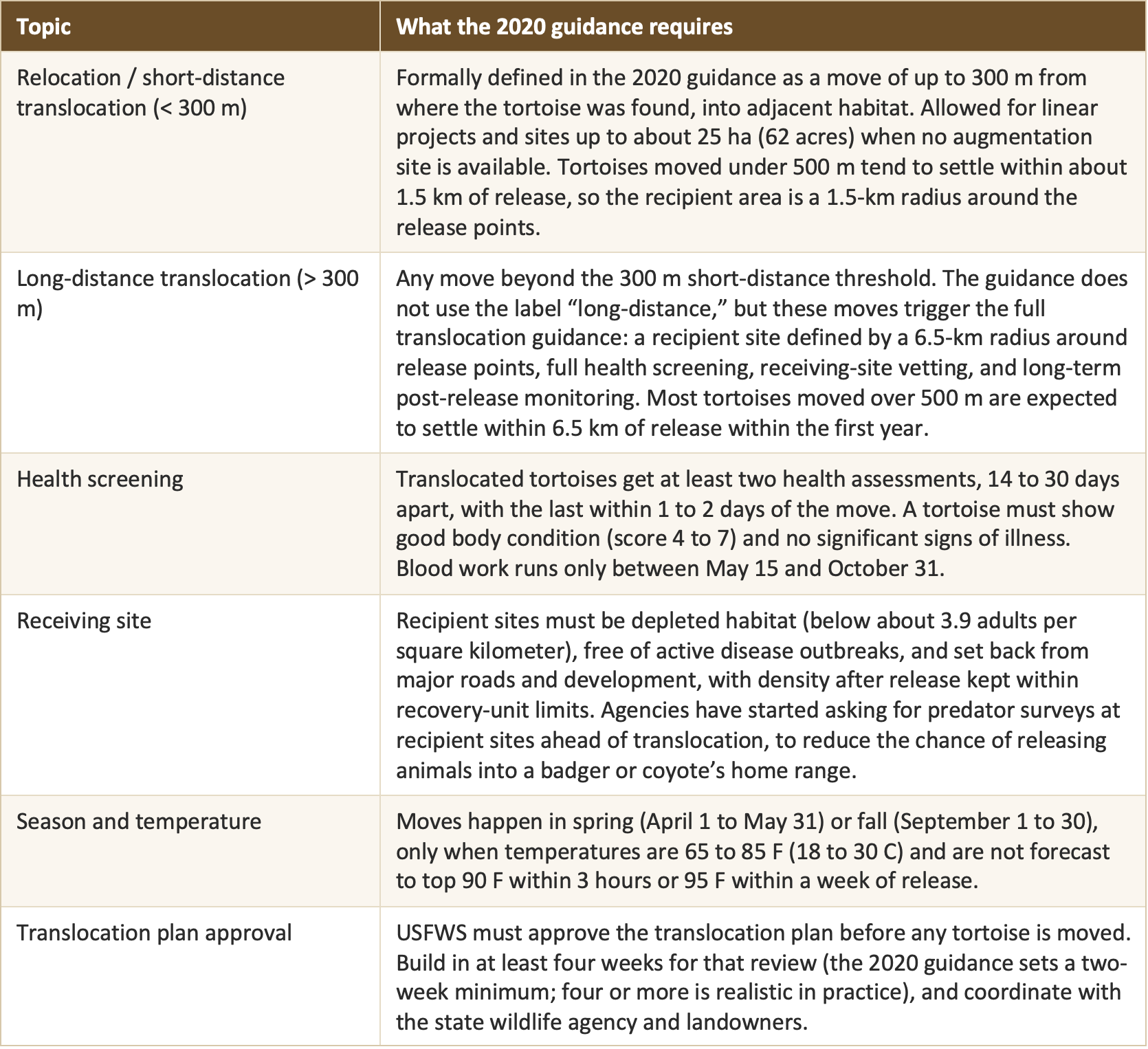
Moving a tortoise off a site is where clearance gets involved, and the terms matter. The 2009 Field Manual drew a line between relocation, moving a tortoise a short distance but keeping it inside its own home range, and translocation, moving it outside its home range to a vetted receiving site under an approved plan. The 2020 USFWS translocation guidance now uses translocation as the umbrella term and folds the older word relocation into it. In plain terms: short local moves within familiar habitat sit at one end, and longer moves to a screened recipient site sit at the other. (USFWS 2009; USFWS 2020 Translocation Guidance)
The 2020 guidance is the most current protocol and sets the specifics. Highlights worth knowing before you budget or schedule:
Tracking tortoises after the move
Moved tortoises are not released and forgotten. Under the 2020 guidance, translocated animals, along with a sample of resident and control tortoises, are tracked with radio transmitters for the first 5 years, inside a monitoring program that can run about 30 years at an augmentation site. Tracking is intensive right after release, often daily to twice weekly in the first weeks, then weekly through the active season and monthly over winter, easing to periodic surveys in later years. Small projects that move only a few tortoises may need about a year of telemetry to document short-term survival. Tortoises too small to carry a transmitter, which must weigh no more than 10 percent of the animal’s body mass, are held in individual quarantine pens and moved at translocation time. (USFWS 2020)
How well does translocation work
Done to protocol, translocations can be successful. A long-term Mojave study found annual survival of translocated wild adults (about 0.90) essentially matched resident adults (about 0.91). Former captives, called waifs, survived at a lower rate (about 0.80). Translocated animals also range more widely in the first year or two before they settle, which is one reason the monitoring runs for years. The translocation site can make or break survival, so strict screening and site selection are key to good outcomes. Plan and budget accordingly. (Farnsworth et al., Mojave translocation study; USFWS 2020)
If you translocate during a drought, hydration before release becomes mandatory. When weather records indicate that tortoises likely have not had a chance to drink within the previous or current active season, or clinical signs suggest a tortoise may be dehydrated, animals must be hydrated within 12 hours before release, and any tortoise that voids its bladder has to be rehydrated too. Drought can also cause thin animals to be held or removed rather than moved, and it can push resident predators to hunt new prey, which raises the stakes on where you release. (USFWS 2020, lines 893-897)
Translocation and predators
Where you release tortoises matters as much as how you move them, and predators are the part of that decision the rules underweight. The 2020 guidance screens recipient sites mainly on tortoise density and disease, not on predator pressure. Yellow Pine Solar showed why that gap is dangerous. In May 2021, about 139 tortoises cleared from the project were moved to Stump Springs, and within a few weeks roughly 30 of them, close to a third of the relocated adults, were killed in a burst of badger predation. Agencies tied it to a bad combination: translocation stress leaving animals disoriented and above ground more than usual, and drought-stricken badgers with new prey dropped at their doorstep. (KNPR; Pahrump Valley Times)
FIELD PRINCIPLE, DESERT SHIELD
Plan a translocation around where the badgers are, not just around where the tortoises will fit. A recipient site that pencils out on density and disease can still be a poor choice on predators, and a resident badger can undo months of clearance work in a couple of weeks.
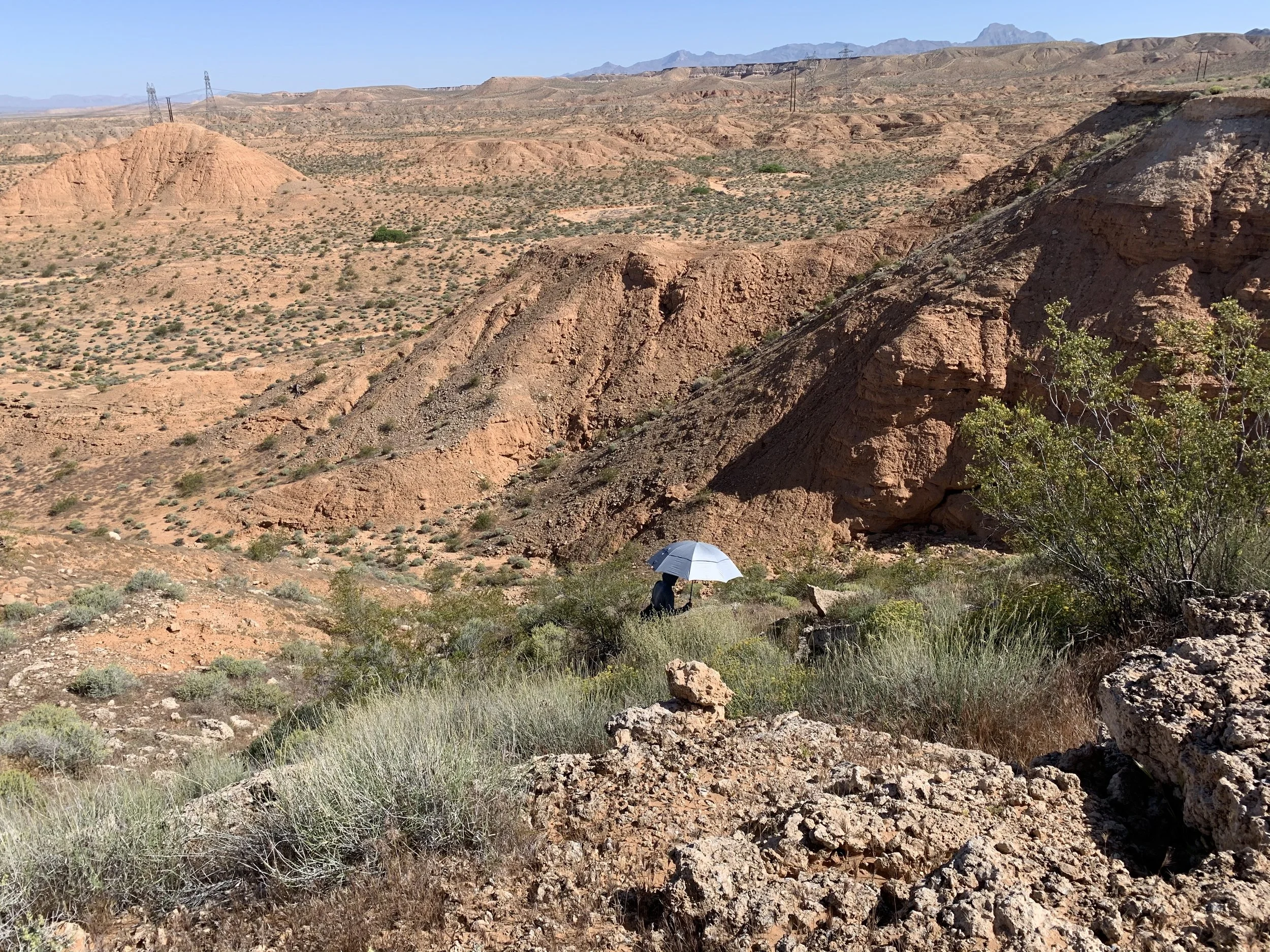
Because of this, agencies sometimes require predator surveys at the release site. It is not yet standard, but it is worth planning for. It means mapping badger, coyote, and kit fox activity and burrows across the candidate recipient area, then steering releases away from active hotspots or adjusting the site if predator pressure is high. Releasing a group of stressed tortoises into unfamiliar ground next to a resident badger is an easy way to lose a large share of the animals you spent months protecting. Your agencies will dictate whether this is required.
Penning a tortoise in place
Sometimes the safer choice is to leave a tortoise where it is and protect it. When a tortoise and its burrow sit next to the work but out of the direct footprint, biologists can build a temporary pen around it: roughly a 6 m circle of buried, tortoise-proof fencing with zero ground clearance. An Authorized Biologist or monitor checks the pen at least daily, and any penning is reported to USFWS within 3 days. Penned or burrow-blocked tortoises are never left during extreme heat, and the enclosure comes off as soon as the nearby work is done. (USFWS 2009)
Reporting
Clearance reporting is quick and specific. The area cleared and the number of tortoises found go to the local USFWS office and the state wildlife agency in writing, within one week. Locations of tortoises, burrows, and any penned or blocked animals are mapped by GPS. Clean, prompt reporting keeps the project in good standing and builds agency trust. (USFWS 2009)
Planning your budget
Clearance and translocation cost more than presence/absence work, and the biggest surprises come from underestimating the long tail of translocation. When you build the budget, account for:
Site size and tortoise density, which set crew size and the number of passes.
Active-season scheduling, since clearance and moves are locked to spring and fall windows.
Exclusion fencing, priced by the linear foot and by terrain, plus ongoing inspection.
Translocation plan development and USFWS review time and edits.
Health assessments and lab work, including sample archival fees (the 2020 guidance cites about $3,000 in 2020 dollars to cover archiving for the monitoring period).
Post-release telemetry, which is intensive in the first months, runs about 5 years, and can extend to roughly 30 years of lower-frequency tracking at augmentation sites.
Predator planning and recipient-site surveys where required.
Agency coordination, reporting, and contingency for a possible third clearance pass or added agency requirements.
A translocation is a multi-year, complex obligation that far outlasts construction.
Reach out when: you are scoping a clearance and want a realistic budget and schedule before it becomes a permit condition. We have run clearances that turned up everything from a handful of tortoises to well over a hundred, and the number drives your crew size, your season, and your cost. Desert Shield can size the effort and staff the Authorized Biologists before the season books out
Common mistakes that happen during translocation
Assuming you can see the back of a burrow or caliche cave when you cannot. Tortoises are excellent at hiding in tight spaces, so your crew must be 100 percent sure before blocking or collapsing a burrow. Every monitor needs direct training and supervision on burrow excavation from an Authorized Biologist.
Assuming a caliche cave is empty because there is no activity. Agencies may require caliche-cave checks across multiple seasons if there is any doubt.
Underestimating the number of caliche caves on your site.
Underestimating the number of tortoises on your site. Moving 8 animals is much cheaper and easier than moving 130.
Not being clear about the long-term tracking requirements.
Not subdividing large projects into smaller fenced areas to make clearance more effective.
Biologists not being aware of the potential for ticks and tickborne illness while excavating.
Not having enough Authorized Biologists to oversee each clearance crew.
Not ordering transmitters or blood-draw supplies in time for your season, or for an unexpectedly large number of tortoises.
Not having a big enough crew to finish the translocation in one season.
Coming next: Part 3, construction monitoring
With the site cleared and fenced, monitoring keeps the project compliant through the build. Part 3 covers the biological monitor’s daily role, worker awareness training, exclusion-fence inspection, the routine safeguards that prevent take, and what to do the moment a tortoise turns up inside a cleared area.
Work with the Mojave desert tortoise specialists
Desert Shield Environmental Professionals runs clearance surveys, translocation and monitoring programs, and predator and raven management support across Nevada, California, Arizona, Utah, and the wider Desert Southwest, with a home base in the Las Vegas and California Mojave. We provide USFWS-approved Authorized Biologists, qualified field crews, and agency-ready documentation. If your project is heading toward a clearance, the earlier we are involved, the more schedule and budget risk we take off the table.
