

A practical guide to desert tortoise exclusion fencing, fence walks, tortoise guards, and shade structures for construction projects in tortoise habitat
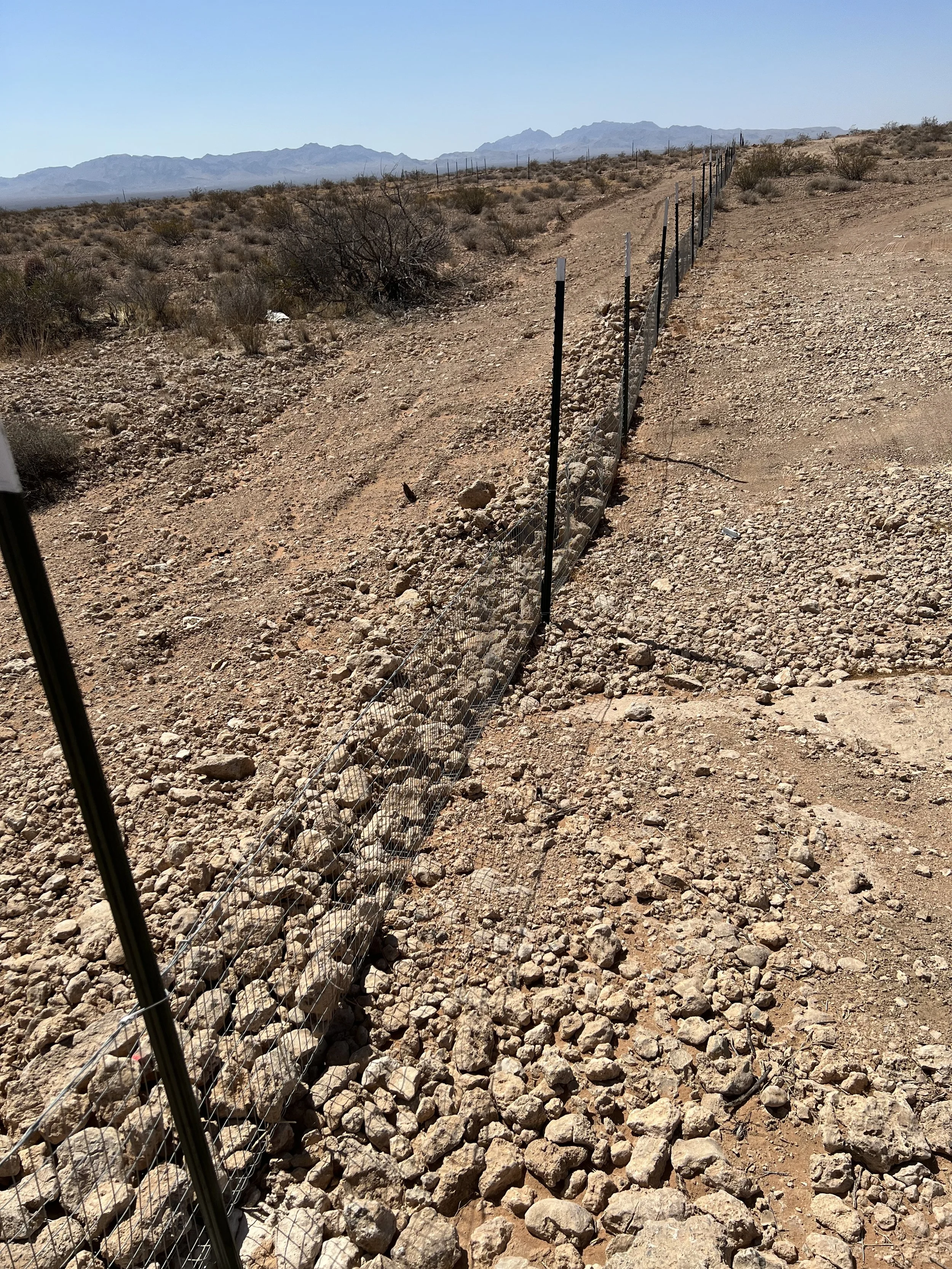
Photo by Caitlin MacMurtrie (Tortoise exclusion fencing for a solar array project in Nevada.)
Desert tortoise fencing sounds simple until the project team is standing in the field trying to install it through caliche, washes, rocky soils, gates, access roads, and active construction areas.
A good fence is protective infrastructure. It is meant to keep desert tortoises out of harm’s way, guide them away from construction areas, and reduce the chance that a tortoise enters a work zone, road, trench, laydown yard, or fenced project footprint.
A poorly installed fence can create the opposite problem. It can leave gaps, trap animals, fail after rain, or cause tortoises to overheat or become exhausted when pacing the fence.
This is why tortoise fencing should be planned, installed, inspected, and maintained regularly.
Quick Field Takeaway
Good tortoise fencing should be tight to the ground, properly buried or anchored, upright, secure at posts and gates, inspected regularly, and tied into a project’s biological monitoring plan. If a tortoise can push under it, climb through it, get trapped by it, or follow it into danger, the fence is not doing its job.
Why Tortoise Fencing Matters
The Mojave desert tortoise is a federally threatened species, and construction in tortoise habitat often requires avoidance and minimization measures before ground disturbance begins.
On many projects, exclusion fencing is used to separate tortoises from active work areas. It may be permanent, temporary, or both. It is usually paired with clearance surveys, biological monitoring, worker environmental awareness training, speed limits, trench inspections, gates, guards, and shade structures.
Fencing is especially important because desert tortoises are slow-moving, hard to see, and often use burrows or shade to survive harsh desert temperatures. The National Park Service notes that desert tortoises spend about 95 percent of their lives in burrows, and that eggs and hatchlings are highly vulnerable, with about 98 percent dying before maturity.
That is the sad part of the story. Desert tortoises are incredibly resilient, but their survival strategy depends on access to the right shelter, shade, soil, burrows, forage, and movement routes. A fence that blocks access to those resources can create real risk if it is not designed and monitored correctly.
What Good Tortoise Fencing Should Look Like
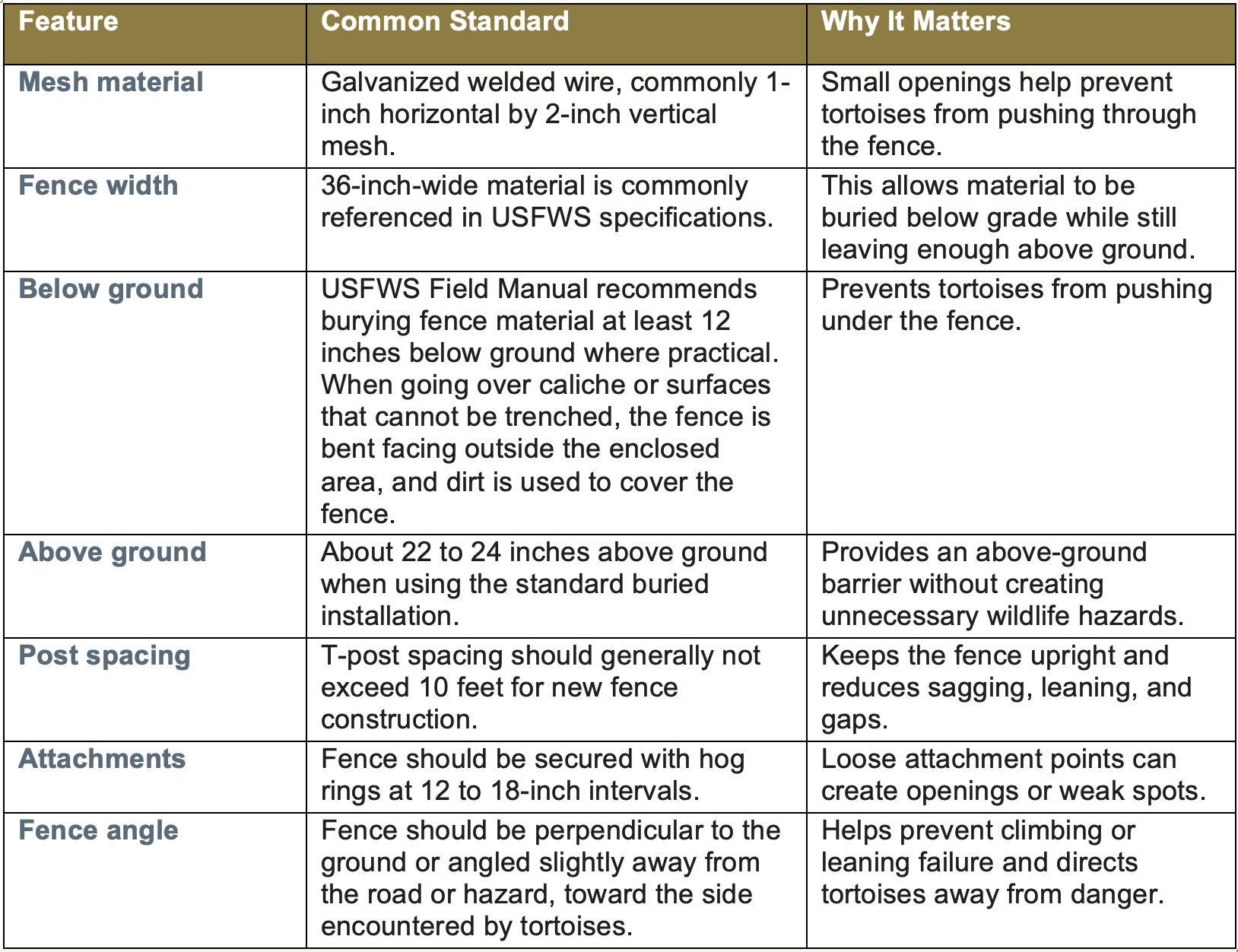
The standard reference for Mojave desert tortoise exclusion fencing is Chapter 8 of the USFWS Desert Tortoise Field Manual. Project-specific requirements may vary, but the Field Manual provides the basic specifications most teams should expect to see.
What Tortoise Fencing Should Not Look Like
A fence can look complete from a truck window and still fail at tortoise level. The most important inspection is close to the ground.
It should not have gaps under the bottom edge.
It should not be loose, sagging, leaning, or curled away from the ground.
It should not have broken mesh, sharp edges, cuts, or unpatched holes.
It should not leave open corners, gate gaps, or unprotected access points.
It should not be installed in a way that channels tortoises into roads, trenches, equipment, or other hazards.
It should not be buried so poorly that rain, erosion, or wind can expose the lower edge.
It should not be treated as “done” once installed. It needs inspection and maintenance.
What If the Fence Is Being Installed on Caliche or Hard Ground?
Caliche and rocky substrates can make standard trenching difficult or impossible. This is where project teams need to slow down and use an agency-accepted alternative, not improvise in the field.
The USFWS Field Manual describes an alternative for rocky or undiggable substrate. Instead of burying the material straight down, the lower portion of the fence can be bent at a 90-degree angle so that a lower section lies flat against the ground surface. That lower section is then covered with soil and cobble so the material is flush and secure.
The goal is the same as standard buried fencing: prevent tortoises from pushing under the barrier. If the fence is sitting on top of caliche with exposed gaps, it is not functioning as tortoise exclusion fencing.
On caliche, rock, wash edges, or uneven ground, the design may need biological and engineering review. The question is not only “Can we install a fence here?” The question is “Will this fence still exclude tortoises after rain, erosion, heat, vehicle traffic, and repeated tortoise contact?”
Fence Walks: When Are They Required?
Fence walks are inspections of the tortoise fence alignment. They are used to check for damage, gaps, washouts, leaning fence, open gates, trapped wildlife, fence-pacing tortoises, and places where repairs are needed.
The exact schedule depends on the project’s Biological Opinion, Incidental Take Permit, agency conditions, and construction plan. However, several common inspection triggers show up across guidance and project BMPs.
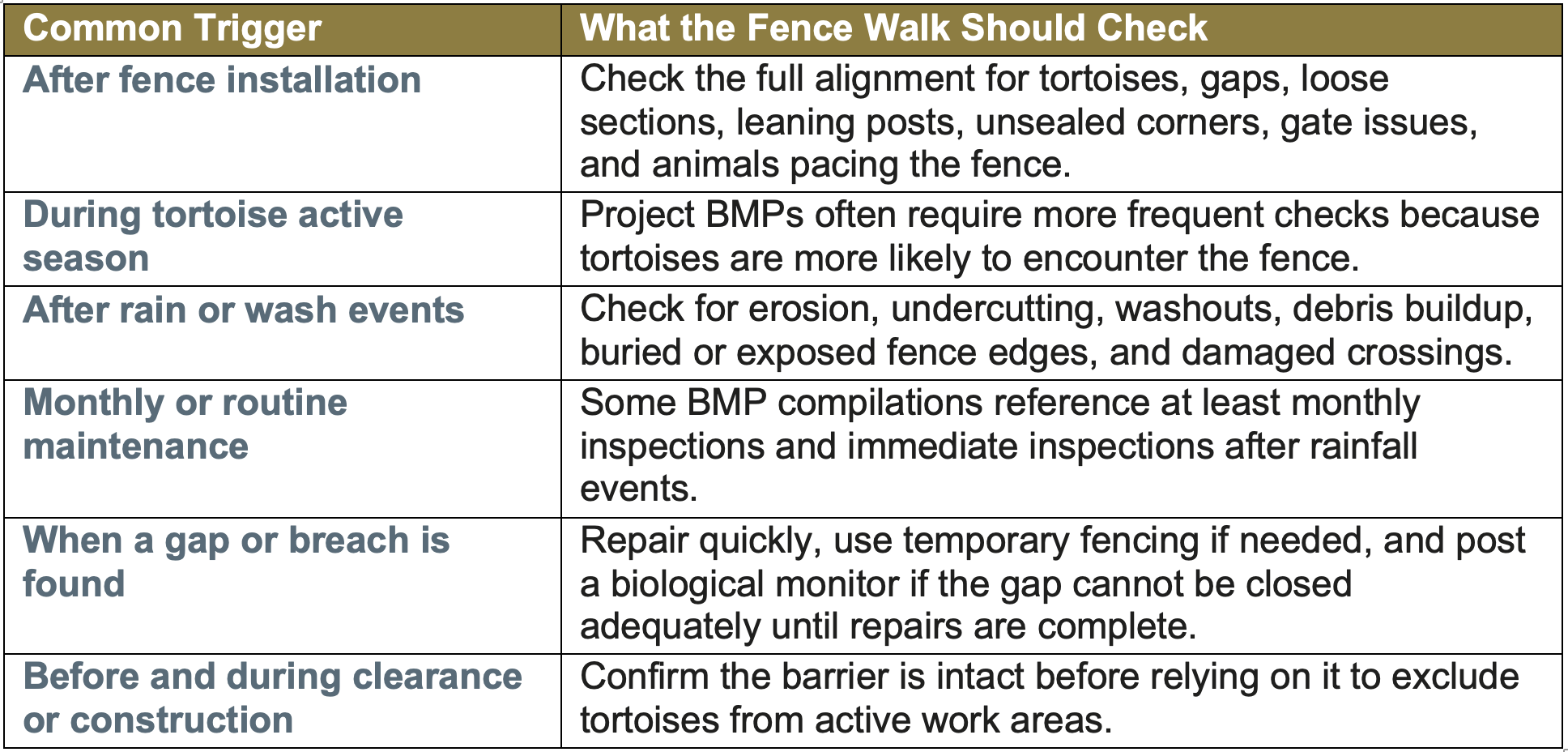
Documentation matters: Fence walks should be documented. Notes should include date, time, inspector, weather or rain conditions, fence segment, GPS point or map reference, damage found, repairs needed, repairs completed, wildlife observations, and photos when useful.
Tortoise Guards: The Cattle Guard Concept for Tortoises
A fence has to open somewhere. Vehicles need to enter, equipment needs access, and gates are often the weak point in the system. That is where tortoise guards can matter.
Tortoise guards function like cattle guards: they allow vehicle access while discouraging or preventing tortoises from crossing into the protected or hazardous side of the fence. They are often considered at gates, access roads, and other unavoidable fence openings.
The Arizona Interagency Desert Tortoise Team guidance notes that gates or gaps in barrier fencing should be constructed and operated to prevent desert tortoise entry, such as by installing tortoise guards similar to cattle guards or keeping gates closed.
Caltrans has reviewed improved exclusion barriers and describes one-slot tortoise guards as a trench deep and wide enough to prevent tortoises from crossing, while still allowing vehicles and people to pass. In the Caltrans summary, the one-slot guard uses two steel I-beams to form a trench about 8 inches wide and at least 8 inches deep, with a surface that helps any animal that falls in right itself and an escape ramp leading away from the road hazard.
Tortoise-proof gates with minimal ground clearance.
Tortoise guards similar to cattle guards at entry points.
One-slot tortoise guards designed as a vehicle-passable trench barrier.
Project-specific guards tied into fencing at access roads, gates, and road crossings.
Escape paths so any tortoise that falls underneath can get out without crossing the intended barrier.
Shade Structures and Artificial Shelter
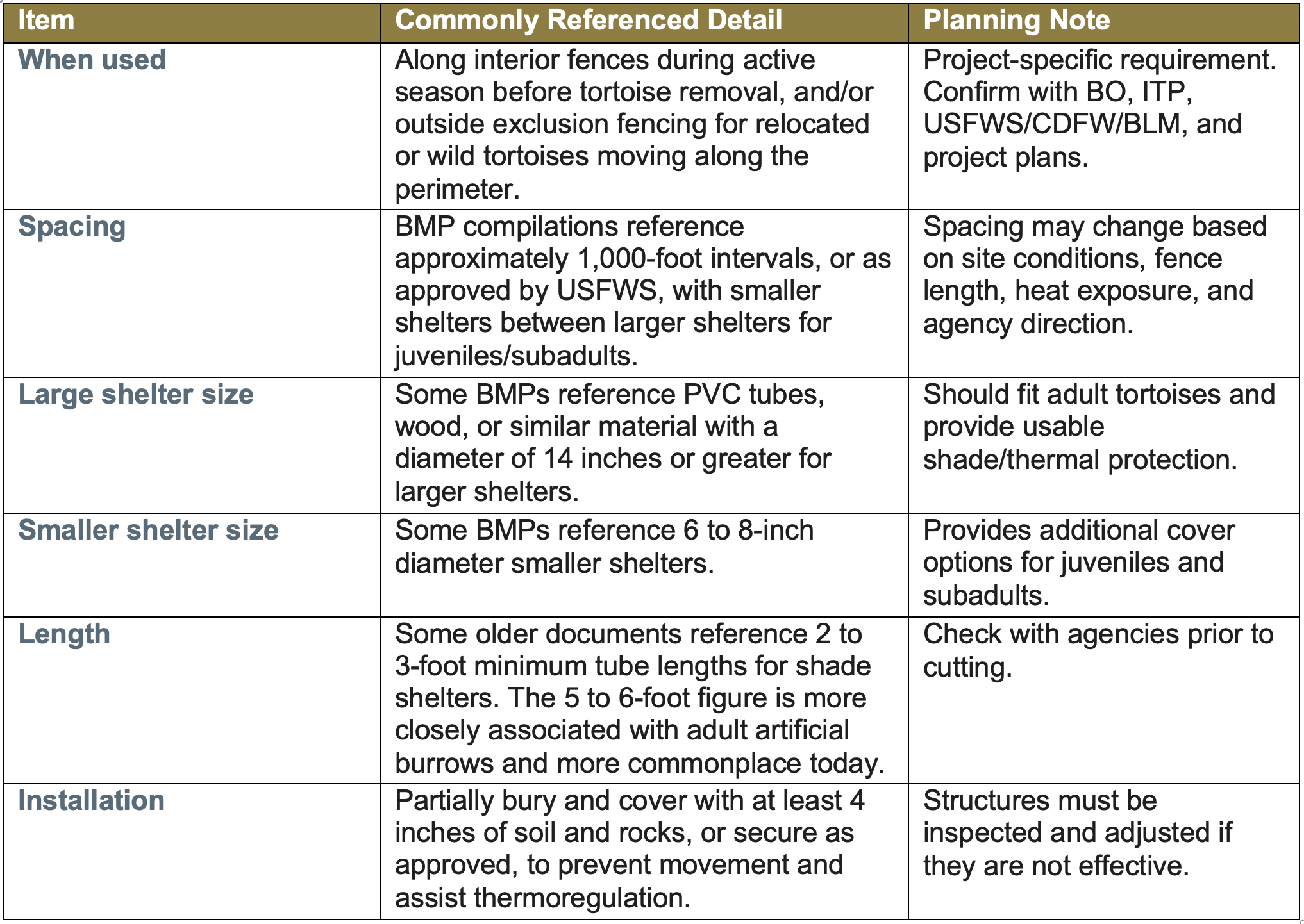
Shade structures are used because tortoises may follow a fence line, attempt to return to their home range, or remain along the perimeter after being moved out of a work area. In hot desert conditions, that can create overheating and exhaustion risk.
Project BMPs frequently require shade structures along interior fences during active season before tortoises are removed from inside the area. Shade structures may also be installed outside exclusion fencing to protect tortoises that were relocated from the project site or tortoises moving along the outside of the project perimeter.
This is also where the 5 to 6-foot number should be used carefully. The USFWS Field Manual uses 5 to 6 feet as a recommended adult artificial burrow length. Shade structures can be different and are often described in project BMPs as 18’ PVC tubes or corregated platic tubes, cut in half longwise and partially buried and covered with soil or rocks. The final design should follow the current USFWS guidance and project permit conditions. Reach out to USFWS if you aren’t sure, as shade structures can be expensive.
Small Details That Make a Big Difference
Fence corners should be tight and closed. Open corners are common entry points.
Gates should close completely and should not leave a ground gap a tortoise can enter through.
Fence bottoms should remain buried, covered, or flush with the ground even after rain.
Wash crossings and drainage areas need special attention because water and debris can damage the fence.
Materials staged near the fence should not create ramps or shade traps that attract tortoises into unsafe areas.
Fence lines should be mapped so crews know what to inspect and where repairs are needed.
Repairs should be made quickly. A small gap can become a compliance issue if a tortoise enters the work area.
Questions Project Teams Should Ask Before Installing Fence
Is the fence temporary or permanent?
Which agency-approved specifications apply?
Does the project require 1-inch by 2-inch galvanized welded wire or is a different material approved for temporary fencing?
Will the fence be buried 12 inches, bent outward, or installed with another approved alternative?
Where are the caliche, washes, rocks, slopes, gates, and access roads?
Where are tortoise guards, gates, or cattle-guard-style access points needed?
How soon do we need to order them?
Are shade structures or artificial burrows required along the fence?
Who will conduct fence walks and how often?
How will fence inspection findings be documented?
How Desert Shield Can Help
Desert Shield Environmental Professionals supports project teams with desert tortoise surveys, biological monitoring, construction monitoring, compliance planning, WEAP training, field documentation, and tortoise protection infrastructure planning across the Desert Southwest.
Our team can help project teams understand what the fence needs to do, where installation problems may occur, and how fence inspections, tortoise guards, shade structures, and clearance work should be built into the construction schedule.
Reviewing project plans for tortoise fencing and access points.
Supporting agency-ready field documentation and inspection logs.
Providing biological monitors during fence installation and construction.
Identifying gaps, erosion, gate issues, and high-risk fence sections.
Helping coordinate fence walks and compliance reporting.
Supporting worker training so crews understand why fence integrity matters.
Helping project teams plan for shade structures, tortoise guards, and site-specific field constraints.
If your project may require desert tortoise exclusion fencing, contact Desert Shield early. The best time to solve fencing problems is before the fence is installed, before clearance surveys begin, and before the construction schedule depends on a barrier that may not be functioning correctly.
Sources and Links Used
USFWS Desert Tortoise Field Manual: https://www.fws.gov/media/desert-tortoise-field-manual - Used for Mojave desert tortoise field manual, handling caution, exclusion fence specifications, alternate rocky-substrate installation, and inspection concepts.
USFWS Desert Tortoise Field Manual PDF: https://www.fws.gov/sites/default/files/documents/Desert-Tortoise-Field-Manual.pdf - Used for Chapter 8 desert tortoise exclusion fence specifications and Chapter 6/7 field considerations.
USFWS Protective Fencing for Desert Tortoise Habitat: https://www.fws.gov/media/protective-fencing-desert-tortoise-habitat - Suggested public-source photo reference for good fencing example, pending final usage/credit review.
Desert Tortoise Council BMP Compilation: https://deserttortoise.org/wp-content/uploads/dtc_construction_BMPs_090517.pdf - Used for common biological opinion/BMP measures, fence checks, rainfall inspections, temporary fencing, and shade shelter guidance.
Caltrans Improved Exclusion Barriers for Desert Tortoises: https://dot.ca.gov/-/media/dot-media/programs/research-innovation-system-information/documents/preliminary-investigations/improved-exclusion-barriers-for-desert-tortoises-pi-a11y.pdf - Used for tortoise guard/cattle guard discussion and one-slot tortoise guard design concept.
Arizona Interagency Desert Tortoise Team Recommended Measures: https://www.blm.gov/sites/default/files/policies/IMAZ-2012-031-a3.pdf - Used for long-term fencing, mesh size, above/below ground guidance, and gates/gaps/tortoise guards.
National Park Service Mojave Desert Tortoise Facts: https://www.nps.gov/moja/learn/nature/desert-tortoise.htm - Used for engaging tortoise facts, including burrow use, lifespan, and hatchling vulnerability.
NFWF Mojave Desert Tortoise Recovery Implementation Plan: https://www.nfwf.org/sites/default/files/2022-05/mojave-desert-tortoise-implementation-plan-2022.pdf - Used for broad context on threats such as roads, development, predation, invasive plants, and wildfire.
USFWS Translocation of Mojave Desert Tortoises from Project Sites: https://www.fws.gov/sites/default/files/documents/Revisedhttps://www.fieldfence.org/fieldfence/desert-tortoise-exclusion-fence.html%20USFWS%20DT%20Translocation%20Guidance.20200603final.pdf - Used for confirming artificial burrow length context and translocation planning references.
Desert Tortoise Exclusion Fence – Welded Wire Fence & Studded T Post - https://www.fieldfence.org/fieldfence/desert-tortoise-exclusion-fence.html
